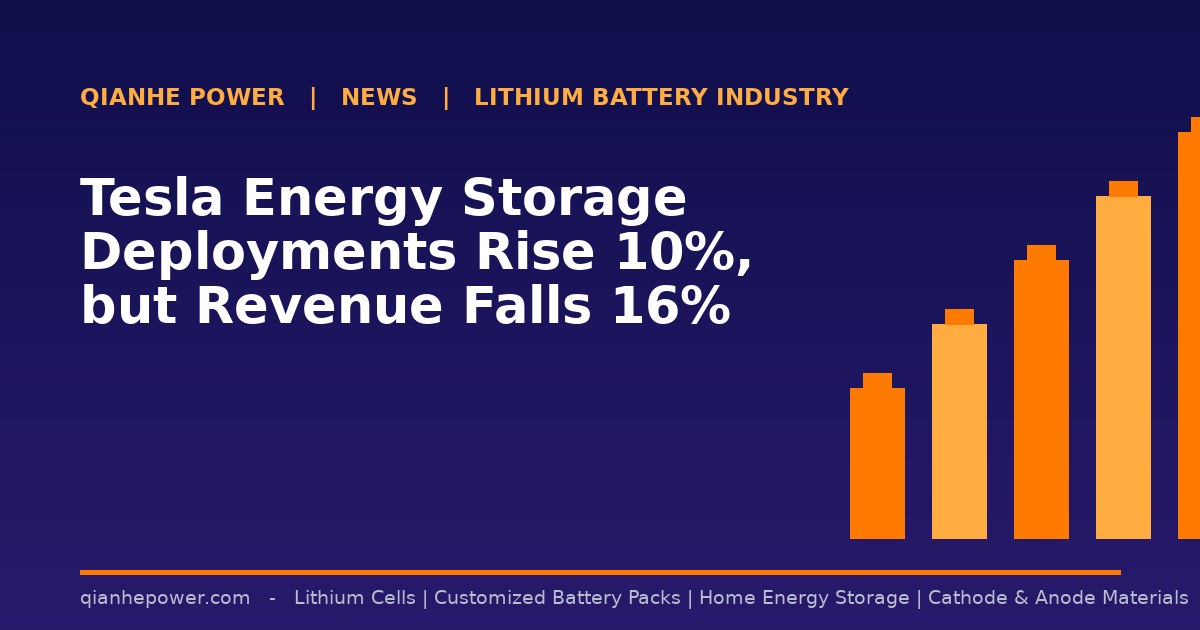
Tesla deployed more batteries in the third quarter of 2026, but its energy generation and storage revenue declined 16% year over year to $2.88 billion. Storage deployments increased 10% to 13.7 GWh, according to Electrek, while Tesla’s shareholder letter attributed part of the revenue decline to tariff-related customer refunds. For lithium battery buyers, the divergence between rising deployment volume and falling revenue highlights the need to evaluate not only battery availability, but also pricing, commercial terms and the impact of tariffs on landed costs.
Why It Matters
The 10% increase in storage deployments indicates continued growth in battery system activity, even as reported revenue moved in the opposite direction. Buyers tracking cells, custom battery packs and energy storage systems should therefore avoid treating deployment growth alone as evidence of stronger revenue or pricing conditions. The reported combination—13.7 GWh of storage deployments alongside $2.88 billion in energy generation and storage revenue—offers a market signal that requires closer examination.
Tariff-related customer refunds were cited as a partial reason for the revenue reduction, but Tesla did not disclose the amount refunded, the customers involved or why the refunds were recorded as reduced revenue. For procurement teams, this lack of detail matters because refunds tied to tariffs can affect quotations, contract structures and the comparability of supplier economics. A buyer comparing large-scale supply agreements should ask whether pricing already reflects tariff-related adjustments and how changes in duties would be allocated between supplier and customer.
The data also reinforces the need to separate physical battery demand from financial performance. More deployed capacity does not necessarily mean higher cell prices or better commercial terms. Buyers should assess supplier capacity and lead times alongside contract pricing, refund provisions, warranty allocation and the precise accounting treatment of any tariff-related adjustments.
Implications for Buyers
Buyers should ask cell and battery-pack suppliers:
- Does the quotation include all tariff-related costs, and how will any future duty changes affect unit prices, lead times and delivery schedules?
- Which cell specifications, pack designs and quality-control certifications support comparable storage deployments, and what production capacity is available to meet forecast demand?
- How are tariff-related refunds, price adjustments and other commercial concessions handled in supply contracts, and what documentation will support cost or volume verification?
Source: electrek — https://electrek.co/2026/10/21/tesla-energy-revenue-drops-tariff-customer-refunds/